
Last updated: 24 November 2026
Businesses rely on email to send invoices, contracts, payment instructions and confidential information. However, criminals can exploit the trust people place in an organisation by sending fake emails that appear to come from its domain.
DMARC is an important part of email security because it helps prevent this type of impersonation, known as domain spoofing.
What is DMARC in email security?
DMARC stands for Domain-based Message Authentication, Reporting and Conformance. It is an email authentication standard that allows domain owners to specify how receiving email systems should handle messages that fail DMARC checks.
Unlike traditional spam filters, which primarily help protect people from incoming threats, DMARC helps protect others from fake emails that appear to come from your domain.
This is particularly important for financial services providers, law firms, accountants and other businesses whose clients rely on trusted email communications.
How do DMARC, SPF and DKIM work together?
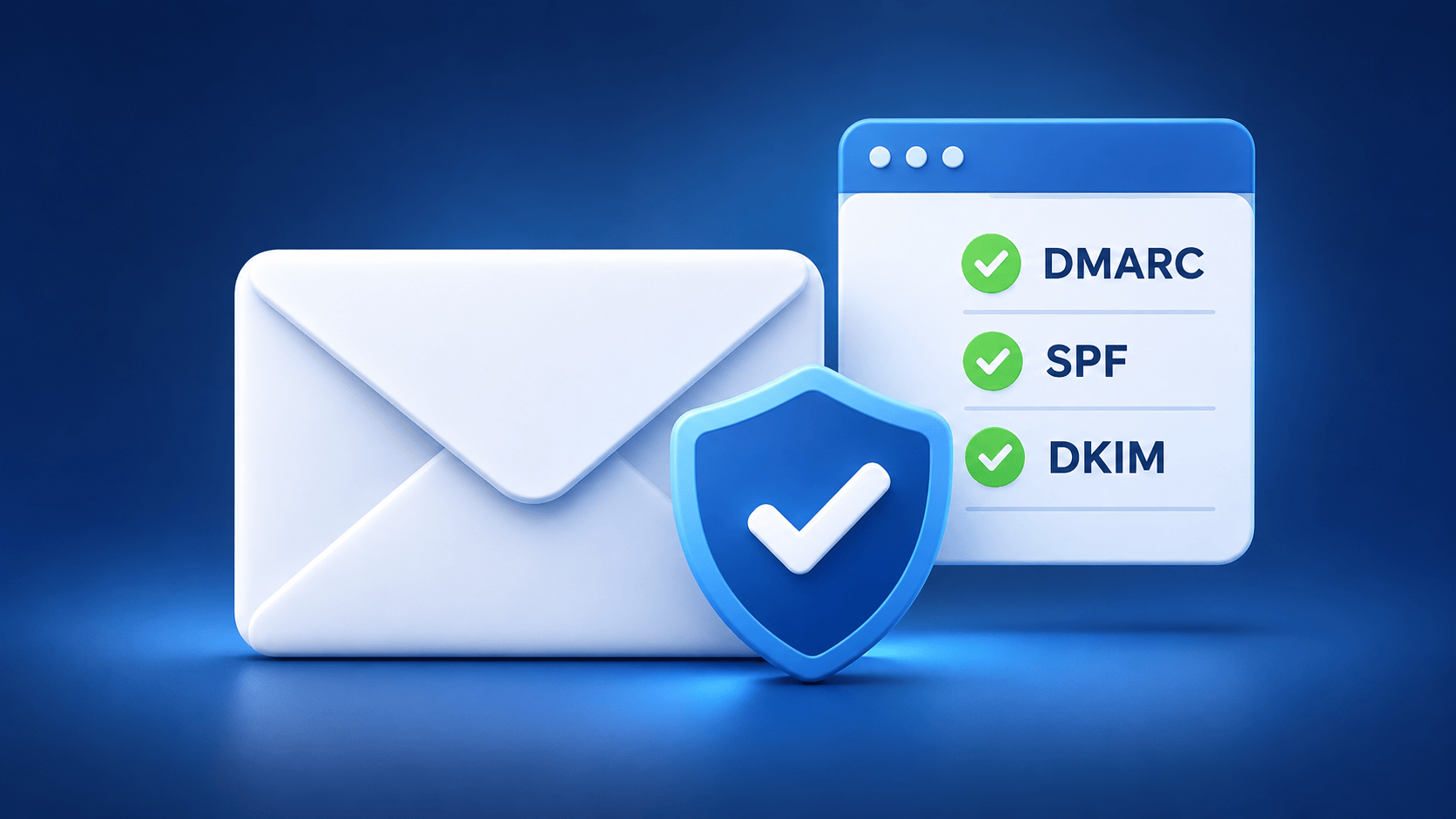
Three complementary mechanisms support email authentication:
- SPF (Sender Policy Framework): Identifies which sending systems are authorised to send email for a domain used in the email’s technical sending address.
- DKIM (DomainKeys Identified Mail): Uses a digital signature to help verify the sending domain and confirm that signed parts of an email have not changed.
- DMARC: Checks whether successful SPF or DKIM authentication aligns with the domain shown in the visible From address.
Together, these mechanisms help receiving email systems distinguish between authenticated messages and potential domain spoofing.
Understanding the three DMARC policies
Publishing a DMARC record does not necessarily mean your domain is protected against spoofing. The level of protection depends largely on the policy you publish.
- Monitoring (p=none): Provides visibility through reporting but does not request that receiving email systems block messages that fail DMARC checks.
- Quarantine (p=quarantine): Requests that receiving systems treat failed messages as suspicious, typically directing them to spam.
- Reject (p=reject): Requests that receiving systems block messages that fail DMARC checks. This is the strongest DMARC policy setting.
The objective is to reach full enforcement while minimising disruption to legitimate email.
Why DMARC monitoring alone is not enough
DMARC reports provide valuable insight into the systems and services sending email using your domain.
For example, your business may use accounting software, marketing platforms, customer management systems and other third-party services to send emails.
Before moving towards enforcement, you need to identify legitimate sending sources and address authentication gaps.
However, monitoring alone does not close the spoofing gap. Organisations need to act on the information and progress towards DMARC enforcement.
What does DMARC protect against?
Properly implemented DMARC enforcement helps reduce the risk of criminals impersonating your exact email domain.
This can help mitigate:
- Fake invoices and fraudulent payment instructions.
- Phishing emails impersonating your organisation.
- Direct domain spoofing.
- Certain forms of business email compromise.
- Reputational damage resulting from domain impersonation.
However, DMARC does not prevent every form of email fraud. Criminals may still use lookalike domains, misleading display names or compromised legitimate email accounts.
Therefore, DMARC should form part of a broader email security strategy.
Why DMARC requires ongoing management
Achieving enforcement is an important milestone, but businesses rarely maintain the same email environment indefinitely.
New software, marketing platforms and other sending services can introduce authentication gaps. Changes to existing systems may also affect legitimate email delivery.
Ongoing DMARC monitoring helps identify new sending sources and authentication issues, allowing organisations to address them while maintaining protection.
Make email domain protection part of your cyber governance
Protecting your domain is not only an IT responsibility. It also supports client trust, proactive risk mitigation and responsible cyber governance.
For example, boards, insurers, brokers and compliance teams may need evidence of the measures an organisation has in place.
ARMD.digital’s Email Trust Status provides a point-in-time Cyber Governance Record of your domain’s publicly visible email authentication settings, including its DMARC enforcement level.
Is your domain protected against email spoofing?
You can check your domain’s current DMARC status using our free DMARC checker.
For businesses looking to implement or strengthen their protection, ARMD.digital provides Managed DMARC Protection, powered by the enterprise-grade Red Sift OnDMARC platform.
We manage implementation, monitoring and progression towards enforcement, helping you maintain protection as your business evolves.
View pricing, generate a quote or get started online without the need for a sales call.


